


If you’ve ever stood in one part of Nigeria where a 5G video call runs smoothly, then travelled just a few kilometers and struggled to load a simple webpage, you’ve already experienced what experts call the digital divide.
It is not just a technical gap, it is the difference between a connected economy and an excluded one, between a student who learns online without interruption, and another who cannot even download a PDF assignment, between a small business that scales digitally, and another that loses customers because payment links fail to load.
Nigeria has made closing this gap a national priority through broadband expansion, telecom infrastructure rollout, fiber optic deployment, and broader digital economy reforms under its national ICT and digital transformation agenda, within that context, China’s involvement is not new, not sudden, and not speculative it is part of a long-standing and well-documented pattern of infrastructure cooperation between China and Nigeria across telecommunications, fiber networks, and digital infrastructure development.
The Real Digital Divide in Nigeria
The digital divide in Nigeria is structural, not temporary, it exists across major layers, Urban centers like Lagos, Abuja, and Port Harcourt enjoy stronger connectivity compared to rural and semi-urban regions, Even where networks exist, affordability of data and devices limits access, Uneven fiber optic coverage, limited broadband penetration in remote areas, and inconsistent last-mile connectivity.
This means the challenge is not just about “internet access.” It is about infrastructure distribution and digital equity, for Nigeria, bridging this gap is central to unlocking economic growth, improving education access, expanding fintech adoption, and enabling smart public services.
Don't MIss This Article

China’s Established Role in Nigeria’s Digital Infrastructure
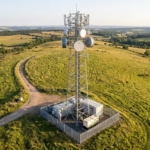
China’s involvement in Nigeria’s digital infrastructure is not theoretical it is already embedded in existing telecom and ICT systems, over the past two decades, Chinese technology companies and state-backed infrastructure financing mechanisms have participated in, telecommunications network development and modernization projects, fiber optic backbone expansion initiatives, ICT infrastructure deployment supporting mobile operators, equipment supply for telecom base stations and broadband systems, digital backbone systems that support parts of Nigeria’s telecom ecosystem
Companies such as Huawei and ZTE have played significant roles in supplying telecommunications equipment used across Africa, including Nigeria, especially in broadband rollout and mobile network expansion, this long-standing involvement places China as one of the major external partners in Africa’s telecom infrastructure evolution, alongside European and American technology providers.
Why Nigeria Is Central to the Conversation
Nigeria is not just another African market, it is the continent’s largest economy and one of the fastest-growing digital consumer bases in the world.
Don't MIss This Article

Key structural realities driving its importance include, a population exceeding 200 million people, one of Africa’s highest mobile internet usage rates, rapid fintech adoption and mobile payment growth, expanding demand for cloud services and data infrastructure, government-backed digital economy transformation strategies
These factors create both demand pressure and investment opportunity, for any global infrastructure partner including China Nigeria represents a critical node in Africa’s broader digital transformation landscape.
Broadband Expansion and Fiber Optic Growth
Nigeria’s digital divide strategy is heavily dependent on expanding broadband infrastructure, this includes, national fiber optic backbone expansion, rural broadband penetration programs, last-mile connectivity improvements, mobile network densification in underserved regions, integration of ICT systems into public services, fiber optic networks are especially important because they form the backbone of high-speed internet, enabling everything from fintech transactions to cloud computing and smart city systems.
China’s relevance here is not in abstract influence, but in its global experience in large-scale fiber deployment and ICT infrastructure scaling experience that has been leveraged in multiple emerging markets, including African economies.
However, Nigeria’s broadband strategy remains domestically led, with regulatory oversight and planning driven by Nigerian institutions such as the Nigerian Communications Commission (NCC) and national digital economy policy frameworks.
Smart Cities, ICT Development, and the Next Phase
Nigeria’s digital transformation is moving beyond basic connectivity toward integrated digital ecosystems, this includes, smart city planning initiatives, digitized public service delivery systems, expansion of cloud infrastructure, growth in data center ecosystems, integration of IoT and AI into infrastructure planning

These systems require stable broadband, reliable fiber networks, and scalable telecom infrastructure, China’s global expertise in smart city infrastructure development has made it a reference point in international discussions around urban digital systems. However, implementation in Nigeria remains shaped by local policy frameworks, environmental conditions, and domestic economic priorities, behind every policy discussion and infrastructure project is a lived Nigerian experiences, students in Kano trying to submit an online assignment during poor connectivity, traders in Onitsha losing a digital payment because a network drops at the wrong second, job seekers in Enugu missing a virtual interview due to unstable internet, farmers in Nasarawa unable to access real-time market pricing data.
These are not abstract statistics, they are daily realities shaped by infrastructure gaps, and this is exactly why the digital divide is treated as both an economic and social development issue in Nigeria’s policy landscape.
Strategic Opportunity and Policy Balance
Nigeria’s approach to bridging the digital divide is shaped by priorities such as, expanding broadband access nationwide, attracting infrastructure investment into telecom and ICT systems, ensuring digital sovereignty and long-term sustainability
In this context, international partnerships including those involving China are evaluated based on, infrastructure value delivery, technology transfer potential, local capacity development, long-term economic impact, alignment with national digital economy goals. This is not a one-directional dependency model, but a negotiated ecosystem of infrastructure development involving multiple global partners and domestic institutions.
A Connectivity Gap Becoming a Global Priority
The story of Nigeria’s digital divide is not just national it is part of a global race to expand digital access in emerging economies, China’s involvement reflects a broader reality: digital infrastructure is now a strategic global asset, and countries like Nigeria are central to its expansion, but the core challenge remains unchanged, closing the digital divide is not just about building networks, it is about ensuring that every Nigerian regardless of geography or income can access the digital tools that now define education, commerce, healthcare, and opportunity.
As broadband expands, fiber networks grow, and ICT infrastructure deepens, Nigeria’s digital future will depend not only on technology partnerships, but on how effectively those systems translate into real, everyday inclusion, and that is where the true measure of progress lies.