


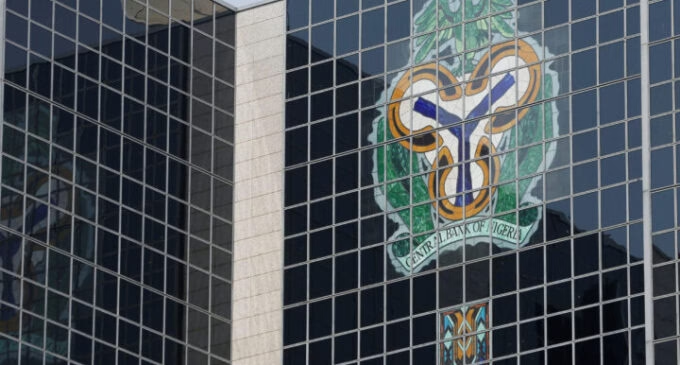
On June 11, 2026, the apex bank released the Exposure Draft Guidelines on Ring-Fencing Operations of Closely Linked Entities in the Nigerian Financial System, signed off by Dr. Rita Sike, Director of Financial Policy and Regulation. In plain terms, the CBN wants to build clear walls between a bank and any “closely linked” company it owns, controls, or shares structure with fintechs, microfinance lenders, payment companies, asset managers, and other affiliates under the same group umbrella.
The goal isn’t to break up these financial groups. It’s to stop one entity’s problems from spilling over into another and to stop companies from using a sister entity’s licence to quietly offer services they’re not approved for. The CBN calls this “regulatory arbitrage,” and it’s been a growing concern as banking, payments, and lending increasingly happen under one corporate roof with very loose internal boundaries.
Under the draft, no more than 20 percent of an entity’s board can sit on the boards of its closely linked affiliates at the same time. Staff sharing is getting squeezed too outside of formal Shared Services arrangements that get CBN sign-off, an employee can no longer work two jobs across two affiliated companies. The era of one back-office team quietly running three different financial brands is being phased out.
Tech systems and data centres are getting separated
This is the part that should worry every tech team inside a Nigerian financial group. The CBN is explicit: an entity cannot use its IT systems to offer services it isn’t licensed for, even if its sister company holds that licence. It also can’t process transactions on behalf of an affiliate through its own platform. And where the CBN judges it necessary, it can force a full separation of data centres meaning the shared cloud infrastructure many groups rely on to cut costs may no longer fly.
For fintech teams used to building once and plugging into the parent bank’s rails, this is a real architecture problem, not just a compliance memo.
Don't MIss This Article

Money can’t move freely between affiliates anymore
Every regulated entity will now have to meet its own capital and liquidity requirements independently no leaning on a healthier sister company’s balance sheet. Any intra-group loan or liquidity support now needs the CBN’s prior written approval first. Reports following the exposure draft also point to an outright ban on closely linked entities lending to or guaranteeing each other without that same approval. Basically: if your fintech runs into trouble, the parent bank can’t quietly bail it out behind the scenes anymore.
You now get a say when you’re moved between companies
This is the provision that would have saved Tobi a lot of stress. Under the draft, before a customer is shifted onto a service run by an affiliate, the institution has to get the customer’s express consent and clearly disclose which entity is actually providing the service plus what alternatives exist. Some of the reporting around the draft suggests customers could even need to go through a fresh KYC process when they move to a related entity, instead of being silently migrated across linked apps. Knowing exactly who you’re dealing with, and who’s accountable if something breaks, becomes a right rather than a guessing game.
The guidelines also require each closely linked entity to maintain its own recovery and resolution plan essentially a documented answer to “what happens if this entity gets into serious trouble.” Either it has a path back to stability, or it winds down in an orderly way that doesn’t drag the rest of the group, or the wider financial system, down with it.
Don't MIss This Article

Why this is bigger than compliance paperwork
For Nigeria’s banks, fintechs, and the conglomerates sitting on top of both, this draft isn’t just another regulatory memo to file away. It touches product design, shared infrastructure, customer onboarding flows, and how groups have structured themselves for years to move fast and cut costs. Violations once the rules are finalised could carry real teeth reports point to potential sanctions under the Banks and Other Financial Institutions Act (BOFIA) 2020, ranging from fines to management changes to licence revocation.
The CBN has also released a parallel update to its guidelines for financial holding companies around the same time, which signals this isn’t a one-off it’s a broader push to clean up how interconnected Nigeria’s financial groups have become.
Stakeholders have until July 9, 2026, to send in their comments before the rules are finalised. For anyone building, working in, or simply banking with a Nigerian fintech right now, this is the moment to actually read the draft because by the time it becomes law, the convenience of “one app, one login, one group” might come with a lot more questions attached about exactly who’s on the other end.