

Nigeria’s policing system operates under heavy pressure, from dense urban centers like Lagos and Abuja to rural communities across the country, officers are tasked with responding to incidents across vast and sometimes difficult terrain.
But the system still depends heavily on manual processes such as Paper-based reporting in many stations, Limited real-time communication between units, Slow retrieval of case files, Fragmented data across jurisdictions and Dependence on physical eyewitness reports
In many situations, investigations move at the speed of paperwork not the speed of events, and nowadays where information spreads instantly, that gap matters a lot and this is where the conversation around digital policing in Nigeria begins.
A Real-Life Picture Nigerians Understand
If you ask someone in Lagos what “police response delay” feels like, you will likely get a personal story like a phone stolen in traffic, reported immediately but with no clear follow-up, neighbor’s disturbance that escalates while waiting for intervention, a case file that “cannot be found” during a follow-up visit, these are not rare stories, they are everyday realities in many communities.
And they are exactly why discussions around smart police stations in Nigeria are gaining attention not as fantasy, but as a possible evolution of how public safety systems work.
Don't MIss This Article

What AI-Powered Policing Actually Means
Despite how it sounds, AI does not replace police officers, it supports them, an AI-assisted police system is designed to improve how information is collected, processed, and acted upon.
In practical terms, AI in Nigerian policing could support, faster digital reporting systems, automated incident logging, real-time case tracking dashboards, smarter surveillance monitoring systems, better coordination between police units, data organization across multiple stations, instead of replacing human judgment, it reduces the time spent searching for information so officers can focus on response and investigation.
Smart Surveillance: Seeing Patterns Faster
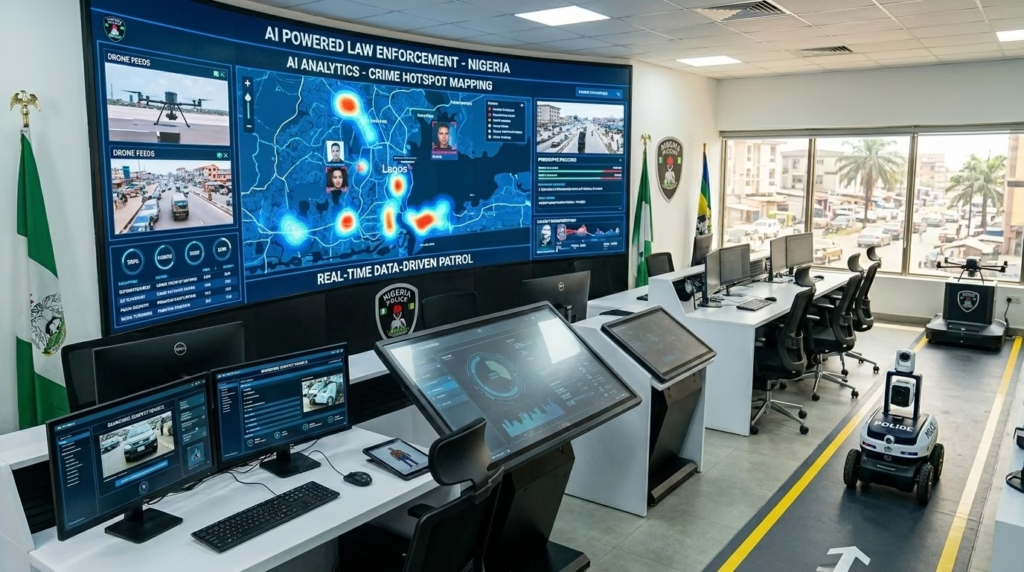
One of the most realistic applications of AI surveillance in Nigeria is intelligent CCTV systems, instead of passive cameras that only record footage, AI-enabled systems can help identify, suspicious movement patterns in real time, abandoned objects in public spaces, sudden crowd build-ups in busy areas, possible security risks in monitored zones
Don't MIss This Article

In a city like Lagos, where movement is constant and unpredictable, this kind of real-time monitoring could significantly improve situational awareness, but it still requires human verification AI flags events, officers decide action.
Predictive Policing: Powerful, But Sensitive
Globally, one of the most discussed ideas in law enforcement technology is predictive policing, the idea is not to “predict crime with certainty,” but to analyze patterns such as, locations with repeated incidents, time-based crime trends, environmental or behavioral risk indicators, in theory, this helps security agencies allocate resources more efficiently, however, in Nigeria’s context, this remains conceptual, not operational.
There is no widespread deployment of predictive policing systems in Nigerian law enforcement today. Any use would require strong legal frameworks, oversight, and safeguards to prevent misuse or bias, so for now, it remains an idea being explored globally not a working system locally.
Digital Case Management: The Most Immediate Upgrade
If there is one area where digital policing Nigeria could realistically improve quickly, it is case management, imagine if, every report is logged digitally, case progress can be tracked electronically, evidence is stored securely in centralized systems, officers across stations can access verified records instantly
For citizens, this would mean fewer repeated visits to police stations and more transparency in how cases are handled, this is less futuristic and more of an administrative modernization step.
Smart Cities and Security Integration
As Nigeria continues to explore smart city infrastructure, security systems naturally become part of the conversation, smart security frameworks could integrate, traffic monitoring systems, emergency response coordination tools, city-wide surveillance networks, digital communication channels between agencies

In this model, policing becomes part of a connected urban system rather than isolated stations working independently, but again, this depends heavily on infrastructure, funding, and long-term planning.
Challenges Nigeria Cannot Ignore
Even with all the possibilities, AI-powered policing in Nigeria faces real constraints, Stable electricity, reliable internet, and digital infrastructure are still uneven across regions, AI systems require continuous funding, upgrades, and technical support, any surveillance or data-driven system must comply with privacy laws and ethical standards, officers need proper training to use digital tools effectively, without transparency, advanced surveillance systems can raise concerns about misuse.
These challenges mean adoption must be gradual, structured, and carefully regulated.
Global Context: Nigeria Is Part of a Larger Shift
Around the world, countries are gradually integrating technology into policing, from smart CCTV systems to digital reporting platforms, law enforcement is becoming more data-driven globally, Nigeria is not behind or ahead in isolationit is part of this global transition, but at a different pace shaped by local realities.
AI-powered police stations in Nigeria are not a reality yet but they are part of an important conversation about the future of security, the real shift happening today is not full automation.
It is digital preparation, from manual files to digital records. From reactive systems to faster coordination. From isolated stations to potentially connected networks, if implemented carefully, AI and smart systems could support Nigerian law enforcement in becoming faster, more organized, and more responsive, but the most important factor will always remain the same, technology must serve people not replace judgment, responsibility, or accountability, the future of policing in Nigeria will not be defined by AI alone, it will be defined by how wisely it is used.