

It starts with something most Nigerians never see but use every single day, a WhatsApp message sent in milliseconds. A Netflix movie streaming without buffering. A fintech app approving a transfer instantly. A banking transaction that completes before the receipt is even checked.
Behind all of this sits an invisible backbone data centres, and in Nigeria today, that backbone is quietly becoming one of the fastest-growing infrastructure markets in Africa, with projections pushing it toward the $1 billion mark.
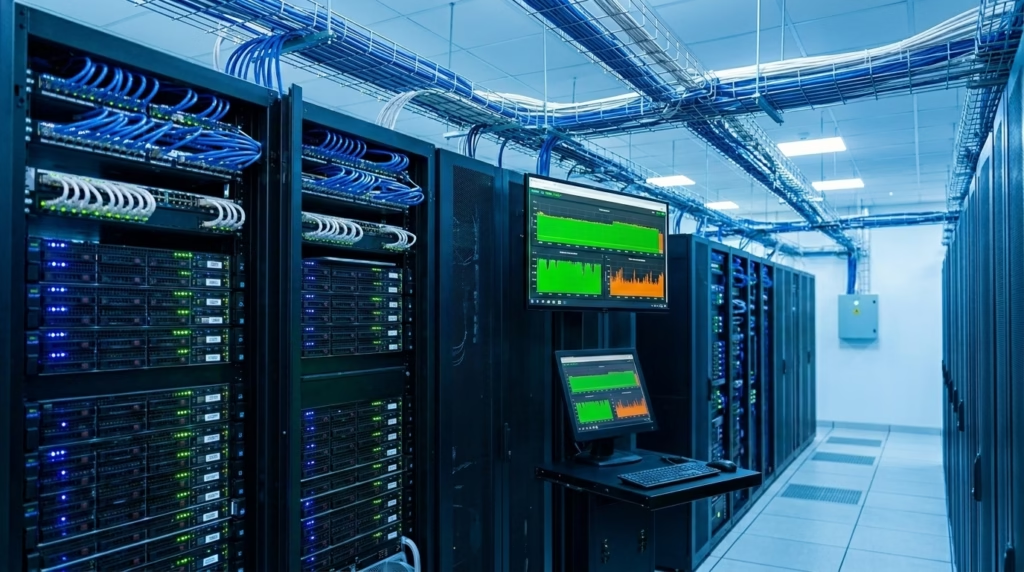
Yet, most of this growth is happening far away from the public eye, inside secure buildings filled with servers, cooling systems, fiber cables, and nonstop electricity backups designed to keep the digital world alive.
The Digital Shift Nigeria Can No Longer Ignore
To understand the rise of the Nigeria data centre market, you have to understand what has changed in the last decade, Nigeria is no longer just a consumer of digital services. It is becoming a producer.
From fintech platforms like mobile money systems to streaming services, cloud-based startups, government digital services, and e-commerce platforms, data is exploding across the country, every transaction, every upload, every video call creates demand for storage and processing power.
Don't MIss This Article

For years, most of this data was hosted outside Nigeria in Europe or North America. That meant slower speeds, higher latency, and increased costs for businesses operating locally.
But that model is rapidly changing, now, companies are building data centres in Nigeria to keep data closer to users, reduce delay, and comply with emerging data sovereignty regulations, the result is a race not just for infrastructure, but for control of Africa’s digital future.
Lagos: The Unofficial Capital of West Africa’s Digital Infrastructure
If there is a heartbeat of Nigeria’s data centre boom, it is Lagos, from Lekki to Eko Atlantic, industrial zones are quietly transforming into hubs of cloud infrastructure Nigeria has never seen before, on the surface, these buildings look unremarkable secure compounds with restricted access, heavy cooling systems humming behind thick walls.
Don't MIss This Article

Inside, however, is where the digital economy lives, thousands of servers process financial transactions, host applications, store government records, and power cloud services used across West Africa.
Telecom companies, fintech giants, and global cloud providers are all investing heavily in colocation services Nigeria, renting space inside these facilities to run their infrastructure more efficiently.
The reason is simple: proximity matters, the closer data is to users, the faster and more reliable digital services become.
Why Nigeria Is Becoming a Data Centre Hotspot
Nigeria’s rise in the global digital economy Nigeria conversation is driven by several powerful forces.
First, population, with over 200 million people and one of the youngest populations in the world, Nigeria generates massive digital activity daily.
Second, mobile-first adoption, most Nigerians access the internet through smartphones, not laptops or desktops. That means constant mobile traffic, app usage, and cloud dependency.

Third, fintech dominance, Nigeria is Africa’s fintech capital. Every mobile payment, bank transfer, and digital wallet transaction adds pressure on local infrastructure.
Finally, government digitization efforts are increasing demand for secure, localized data storage, together, these forces are creating unprecedented demand for data storage Nigeria solutions.
The Rise of Hyperscale and Edge Computing in Nigeria
A major shift shaping the industry is the move toward hyperscale data centres Africa and edge computing Nigeria.
Hyperscale facilities are massive data centres built to handle huge volumes of cloud computing workloads. They are designed for companies like cloud service providers, telecom operators, and global platforms.
Edge computing, on the other hand, brings processing power closer to the user, instead of sending data to a far-away server, edge infrastructure processes it locally reducing latency and improving speed.
For Nigeria, this is critical, imagine a Lagos trader using a payment app during peak hours. Without edge computing, delays could occur. With it, transactions happen instantly.
This combination of hyperscale infrastructure and edge computing is what is pushing Nigeria closer to becoming a regional digital powerhouse.
The Billion-Dollar Race: Who Is Investing and Why?
The projection that Nigeria’s data centre market could hit $1 billion is not speculative hype it is backed by real investment trends.
Major telecom operators are expanding infrastructure, global cloud providers are entering West Africa through partnerships, local tech companies are scaling rapidly, building or leasing space in existing facilities, private equity investors are also paying attention, seeing data centres as long-term infrastructure assets similar to roads or power plants.
But there is a deeper motivation driving this race, data sovereignty, countries across the world are increasingly prioritizing where their data is stored. Nigeria is no exception, by keeping data within national borders, companies reduce legal risk, improve compliance, and gain faster access to digital services, this is why demand for cloud infrastructure Nigeria is accelerating faster than ever.
The Power Problem Behind the Growth
But beneath the optimism lies a challenge that cannot be ignored power.
Data centres are energy-intensive. they require constant electricity, backup generators, cooling systems, and stable grid connections. In a country where power supply is still inconsistent, this becomes a major operational cost.
To solve this, many operators are investing in hybrid energy systems combining grid power, diesel generators, and increasingly, renewable energy sources.
Some facilities are even exploring solar-backed infrastructure to reduce dependency on traditional power sources, without stable energy, the dream of becoming a digital hub could slow down significantly.
Why Businesses Are Moving Their Infrastructure Home
For Nigerian startups and enterprises, hosting data locally is no longer optional it is becoming strategic.
Here’s why:
- Faster application performance for users
- Reduced cost of international data transfer
- Better compliance with data protection laws
- Improved reliability for mission-critical system
From banks to logistics companies to e-commerce platforms, businesses are realizing that digital performance directly impacts revenue, and in a fast-moving economy like Nigeria’s, even a one-second delay can mean lost customers.
The Human Side of a Data Centre Boom
While the infrastructure feels abstract, its impact is very real.
- A farmer in Kaduna using a mobile app to check market prices relies on data centres.
- A student in Ibadan attending a virtual class depends on cloud servers.
- A small business in Port Harcourt processing mobile payments depends on uptime reliability.
This is what makes the Nigeria tech infrastructure growth story different it is not just about corporations or governments. It is about everyday life becoming more digital, more connected, and more dependent on invisible systems.
Challenges That Could Slow the Momentum
Despite the rapid growth, several challenges remain:
Unstable power supply continues to increase operational costs, High import costs for infrastructure equipment affect expansion speed, Limited skilled workforce in advanced cloud engineering and data centre management, Cybersecurity risks as more critical infrastructure goes digital.
However, these challenges are also creating new opportunities for local innovation, training programs, and tech entrepreneurship.
The Road to a $1 Billion Digital Backbone
Nigeria is standing at a turning point, the demand for digital services is not slowing down. In fact, it is accelerating, As fintech expands, AI adoption grows, and cloud computing becomes standard, the need for reliable, local infrastructure will only increase.
The Nigeria data centre market is no longer a niche industry it is becoming the foundation of the country’s digital economy.
The race to $1 billion is not just about money, It is about who controls the infrastructure of Africa’s digital future, and Nigeria, right now, is firmly in the middle of that race.